Agroforestry systems

Transforming food systems with trees

Know more Partners

Introducing trees into agricultural fields

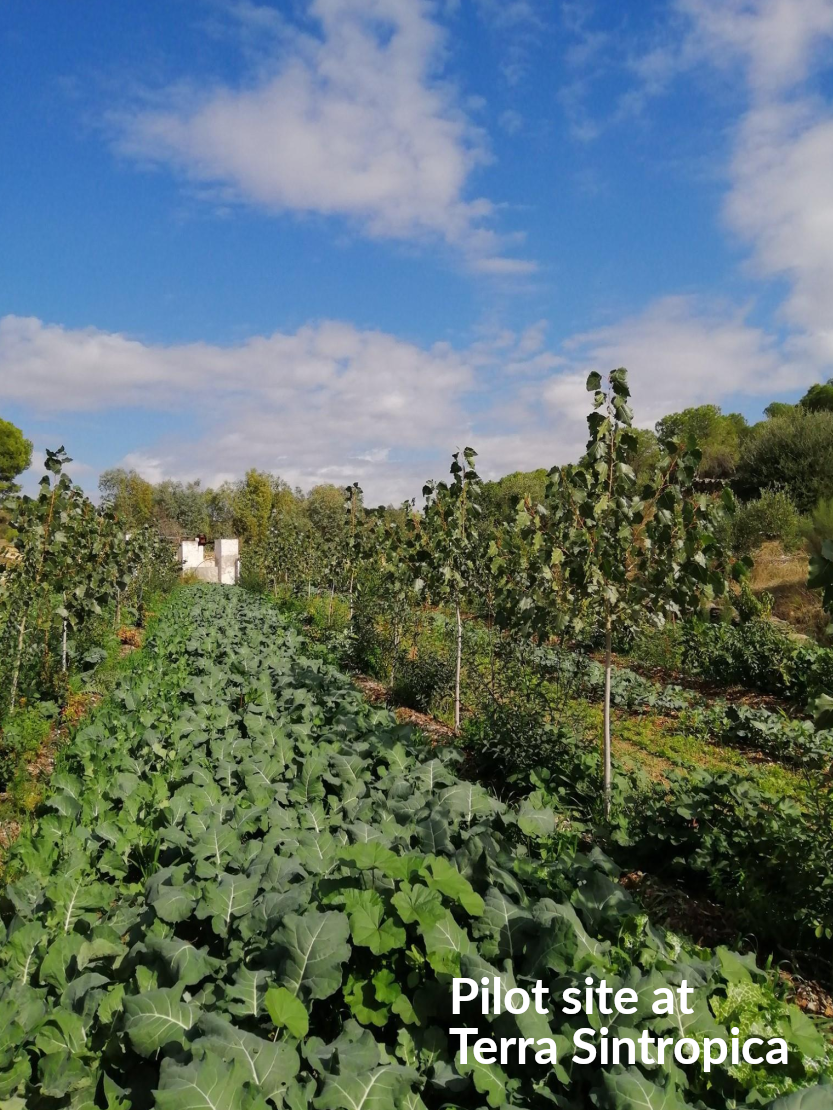
Agroforestry systems (AFSs), which introduce trees into agricultural fields, have been argued to comprise one of the most advanced and effective forms of regenerative agriculture [1]. Despite this, practioners have identified the following needs: i) how to reduce labor costs while maximizing productivity, ii) what to plant beneath and between tree rows and (iii) how to reconcile ecological regulations with economic realities. To address this, our consortium plants shrubs and shade-tolerant herbaceous perennials - such as kale, spinach or rocket within apple or quince orchards, to form multi-strata AFS (msAFS). In contrast to annuals, perennials live for many years and can be used as “permanent” strips in alley cropping, or as “permanent” ground cover within tree rows. Locally sourced food from sustainable low input systems faces significant challenges, as annual crops are highly vulnerable to pests and climate change-driven disruptions in supply chains. Perennials, with their deeper roots and longer growth periods, store carbon and regenerate soils while providing a more stable and reliable food source.

about-image

The consortium

The Root2Fork (R2F) consortium is grouped into four entities referred to as R2F- Living Labs (LLs) that span the European continent (Fig. 1). R2F-LLs in Portugal, Germany, Finland, and Norway closely with retailers and with local kitchens, restaurants, and public canteens (fork level), where chefs integrate edible perennials into menus. To restore nutrient imbalances between the land and sea, and to foster resilience to future climate, perennial seaweed will be gathered at the coast of Norway, and from seaweed farms in Finland and Tanzania to be used on land as fertilizers or biostimulants (Fig. 1). R2F-LLs have pioneered msAFS and will nucleate regional change by the power of example, actively engaging end users and ensuring a demand-driven approach.

Stakeholder engagement

The project will be based on three focus areas that enable direct connection between all stakeholders (especially farmers and consumers) and a global, cross-disciplinary assessment of the impacts of food production:

  1. Consolidating msAFS designs in four R2F-LLs in a participatory approach and bringing innovations that can support the agroecological (AE) transition to market.
  2. Addressing impacts, benefits and trade-offs via multi-actor assessment of ecosystem services, social dimensions, and economic performance of R2F msAFSs by remote sensing and ground truthing, and by participatory testing of assessment tools to select and recommend appropriate indicators.
  3. Bridging the gap from science to (i) application, (ii) policy, and (iii) society via a targeted communication strategy.

about-image

News

Contact

  • info@root2fork.org
  • Emil-Ramann-Str. 4, 85354 Freising, Germany
  • Weekdays 09:00 to 17:00, CET