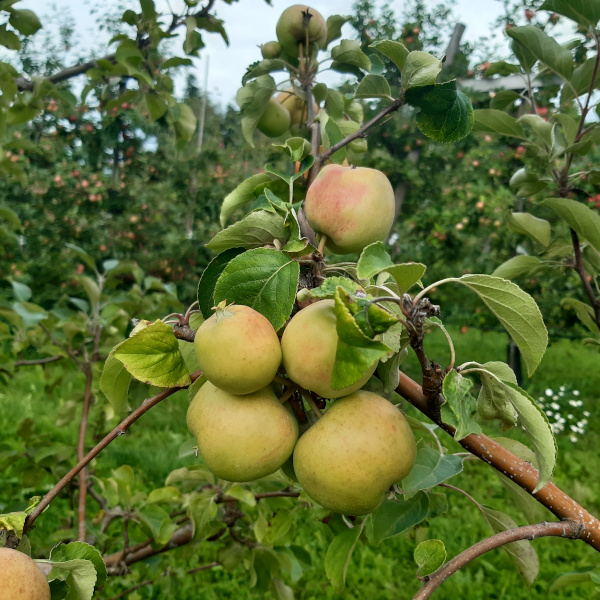
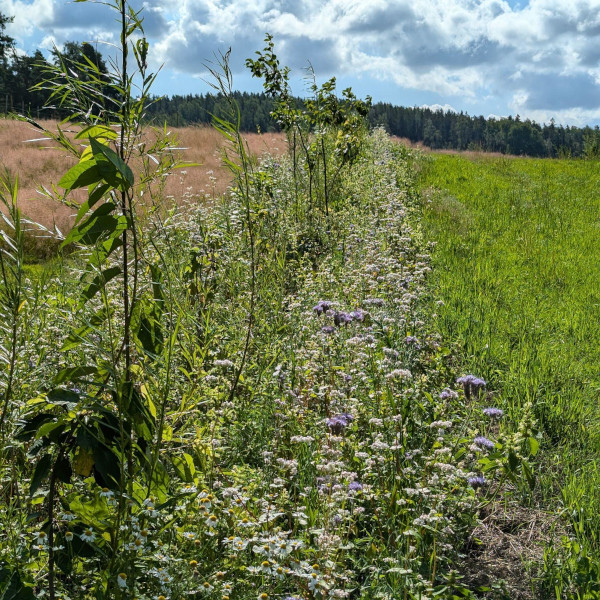
The centerpiece of our living lab is located at the apple orchard of Råbäck Gård on the border of Espoo and Kirkkonummi, Southern Finland, in the Helsinki metropolitan area. The orchard is a commercial apple farm operating with a Community Supported Agriculture (CSA) model, where consumers choose the kind of apples they want and pay for a share from specific trees. This allows the farmer to acquire working capital before the season begins and to know precisely who the customers will be. The farm is situated in a peri-urban rural landscape near the Helsinki metropolitan area. The climate is cool temperate, with cold winters, mild summers, and moderate rainfall.
The key challenges are the short growing season, climate variability, and risks to yields: these are profitability challenges typical of Finnish agriculture. The main opportunities lie in strong local demand for short food chains and CSA models, proximity to urban consumers and direct farmer–consumer interaction.
Co-creation is achieved through close collaboration with the farmer, consumers, municipalities, and other stakeholders. The farmer provides the farm and drives decisions on how the orchard is diversified, while researchers and practitioners work together to design and test agroforestry systems. Local stakeholders – including customers, community members, schools, and potential restaurant partners – are involved through interactions, workshops, and feedback processes, helping shape crop choices, system design, and evaluation. This ensures that experiments reflect real farming conditions, market needs, and community perspectives.
The top two agroecological practices are fostering better habitat above and belowground. In the apple orchard, there is a desire to minimize soil disturbance around the apple trees. Currently a small zone around the trees is weeded mechanically with a tractor mounted system that cuts the roots of weeds growing near the dwarfing apple trees. The plan is to use competitive exclusion to deliberately occupy the low 80 cm and below niche in space around the trees with plants that a) outcompete the weeds, b) do not grow up into the drip irrigation or branch scaffolding of the apple trees, and c) potentially provide sales streams through cut flowers or perennial herbal mixes (the latter would require changes to plant protection products). By doing so, the farmer will also then have perennial root systems from diverse plant families growing near the apple trees, which should feed soil biology and provide habitat for a greater diversity of microbes and fungi. If the system works, the soil will no longer be disturbed in this part of the orchard allowing the growth of long-serving earthworm tunnels, mycorrhizal networks, and more stable soil aggregates.