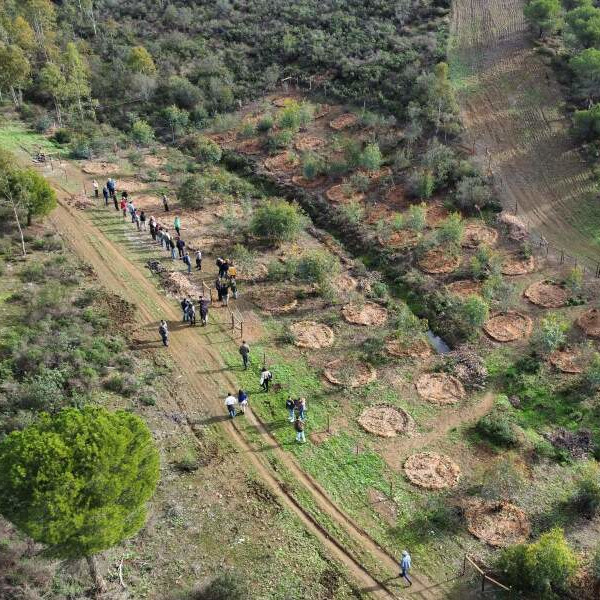
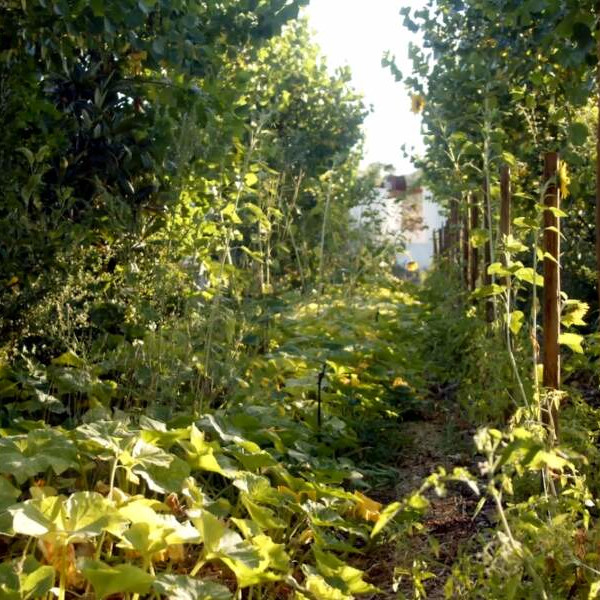
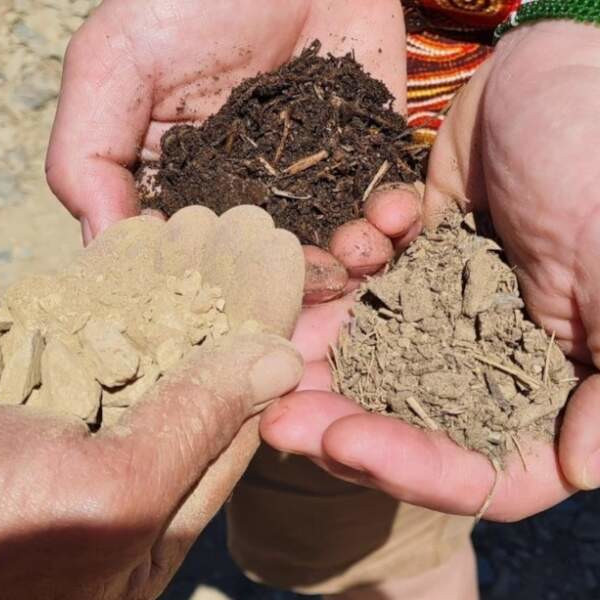
The Portuguese Living Lab is located at Horta da Malhadinha, near Mértola in the Baixo Alentejo region of southeastern Alentejo, Portugal. Situated in one of the southernmost and most inland municipalities of mainland Portugal, it borders Spain along the Guadiana River and marks the southernmost point of the R2F consortium’s European pedoclimatic gradient. The site hosts CARES (Centro de Agroecologia e Regeneração para o Semiárido – Centre for Agroecology and Regeneration in the Semiarid).
Spanning 3.5 hectares, the property functions as an agroecological production farm actively converting into a multifunctional demonstration, experimentation, and capacity-building centre for land and soil regeneration. It operates simultaneously as a commercial farm producing organic fruits and vegetables for local markets, a research site testing successional and msAFS systems, a training centre welcoming farmers, researchers, students, and international visitors, and an anchor for broader territorial networks including the PREC food hub in Mértola town, school forest garden programmes, and an agroforestry nursery.
The Mediterranean South climate presents both defining challenges and opportunities: extremely hot, dry summers with temperatures regularly reaching 46°C; severe and frequent extreme weather events including heatwaves, occasional extreme cold spells, and intense rainfall that accelerates erosion on degraded soils; chronic water scarcity coupled with very low annual rainfall, making irrigation management a central research priority (including biostimulant trials under controlled irrigation conditions); and significant vulnerability to drought and desertification. Located among the regions in Europe most affected by drought, the wider landscape faces ongoing soil degradation and loss of soil vitality.
Educational institutions are a core audience, with free guided visits offered to primary and secondary schools, introducing young people to successional agroforestry and regenerative land management in a hands-on, real-world setting;
Research and higher education partners include universities, research centres, and participants from senior university programmes, who engage with the Living Lab as a site for study, fieldwork, and knowledge exchange;
The farming community is actively involved through immersive training courses and open workshops designed to strengthen the regional agroforestry network and support farmers in adopting climate-resilient practices;
civil society and community actors participate through the local community, volunteers, and interns, contributing to the day-to-day life of the Living Lab and its outreach activities;
at its institutional foundation, the Horta da Malhadinha itself exists through a formal agreement with the Campo Arqueológico de Mértola, which is a non-profit cultural and scientific association linked to an R&D Unit of the Portuguese State’s Science and Technology Foundation.
Co-creation processes are achieved through the systematisation and sharing of information on the principles and fundamentals of agroforestry system design, adapted to the soil and climate conditions of the local stakeholders. In this process, both theoretical and practical knowledge will be valued, with the final design being the result of an ecology of knowledge that brings together the perspectives of the various participants.
Water management through swales and passive retention, permanent soil cover and mulching, polycultures and agroforestry (syntropic systems), organic food productive systems