Multistrata agroforestry combines trees, shrubs and herbaceous crops into layered farming systems that mimic forest structure while delivering food at scale.
The Problem Practitioners Face
Agroforestry systems, which introduce trees into agricultural fields, have been argued to comprise one of the most advanced and effective forms of regenerative agriculture.
In practice, though, farmers exploring agroforestry hit recurring obstacles. Three questions keep coming up:
- How do we reduce labour costs while maximising productivity?
- What should we plant beneath and between tree rows?
- How do we reconcile ecological regulation with economic reality?
These aren’t theoretical. They’re the daily constraints that have historically kept agroforestry in the niche, despite decades of research showing its benefits.
Root2Fork tackles these directly through multi-strata agroforestry systems (msAFS). But what does that actually mean? And how is it different from related approaches you may have heard of?
What is multi-strata agroforestry?
You’ll often see agroforestry terms used interchangeably. They’re not. Below are working definitions aligned with how Root2Fork uses them.
| Term | Short definition |
|---|---|
| Multi-strata agroforestry systems (msAFS) | Farming systems that combine trees, shrubs and herbaceous crops in several vegetation layers, resembling the structure of a forest. |
| Syntropic systems | Agroforestry systems that mimic how forests develop over time, using ecological species succession, multiple strata and strategic pruning, with cut vegetation returned to the soil as mulch. |
| Permaculture | An ecological design approach that integrates food production, water, energy and human needs, guided by care for the Earth, care for people and fair sharing of resources. |
| Food forests | Diverse plantings of mainly perennial food crops - including fruit and nut trees, berry shrubs, climbers and vegetables - designed to mimic a woodland ecosystem. |
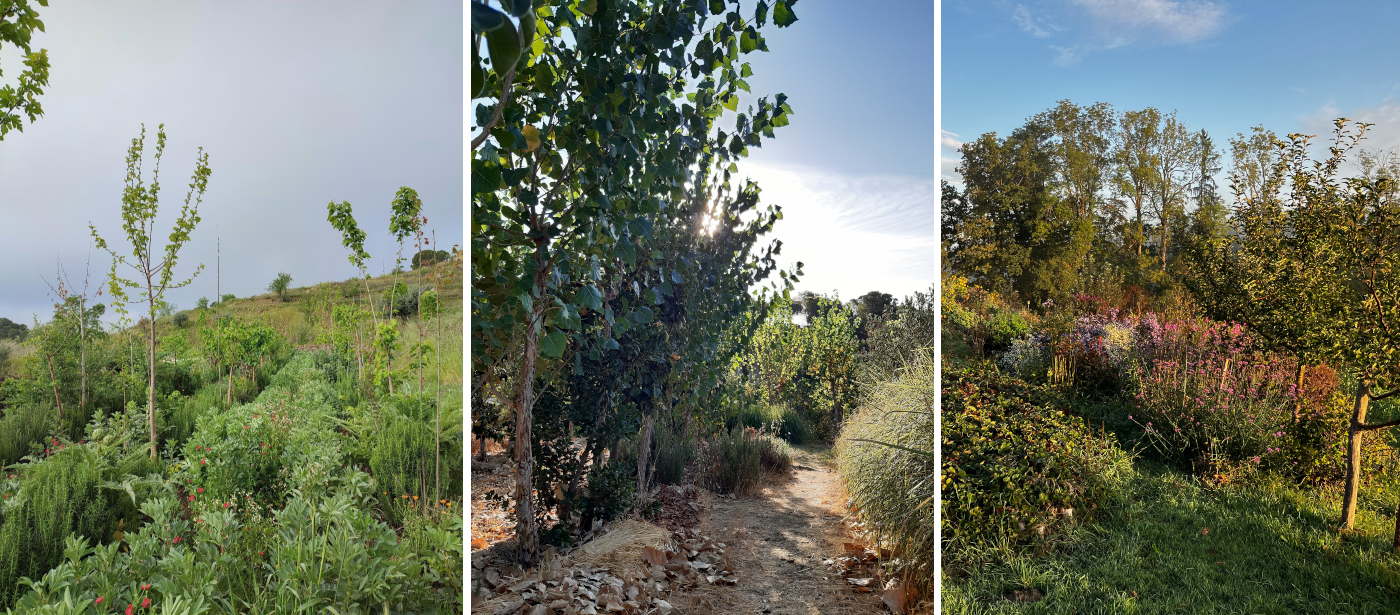
Why the distinction matters: msAFS is a farming system focused on commercial production within layered structures. Permaculture is a design philosophy. Syntropic systems emphasise succession and biomass management, in addition to stratification. Food forests prioritise species richness and perennial edibles over uniform production layouts. There’s overlap, and in practice Root2Fork borrows across all of them, but conflating them makes it harder to communicate what works where.
How Root2Fork builds msAFS
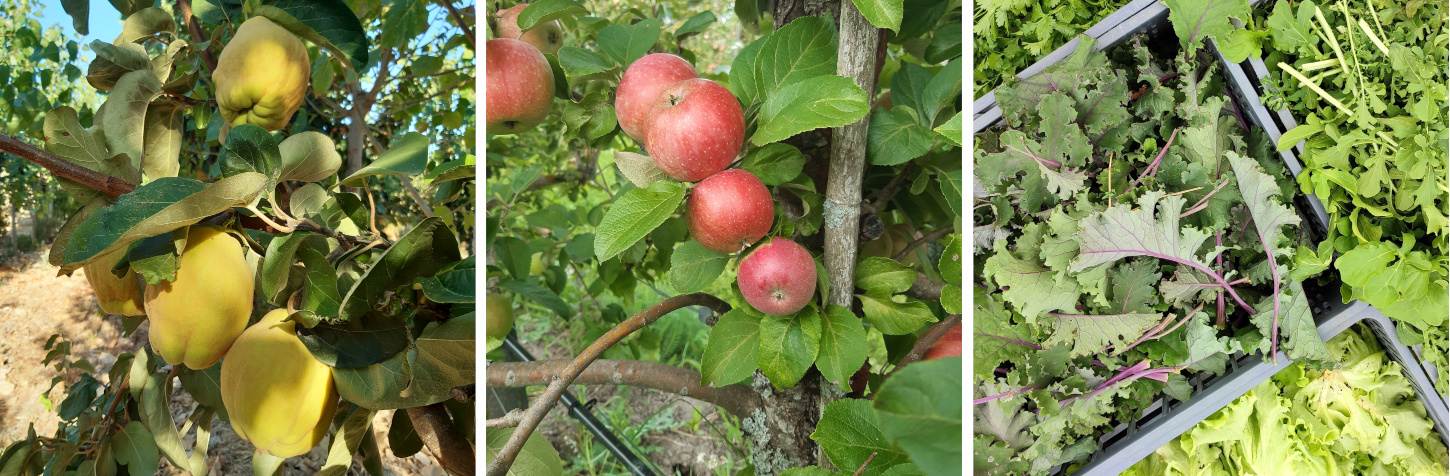
Root2Fork’s configuration is specific: apple or quince orchards forming the overstorey, with shade-tolerant herbaceous perennials (kale, spinach, rocket) planted within and between tree rows. These perennials act as either “permanent” strips in alley cropping or “permanent” ground cover.
This approach is designed to be a straightforward adaptation of (existing) orchard systems, rather than a wholesale conversion. For farmers already managing fruit trees, introducing an understorey of edible perennials is a more accessible entry point than establishing multistrata systems from scratch. The tree layer is already in place; the challenge becomes working with it, not replacing it. This lowers the barrier to trial, shortens the learning curve, and makes scaled uptake more realistic.
What makes these systems work?
Four principles underpin why layered systems outperform monocultures:
- Niche complementarity: Structurally and functionally diverse systems capture light, nutrients and water more efficiently than single-species stands. Each layer occupies a different ecological niche.
- Perennialism: Unlike annuals, deep-rooted perennials are less vulnerable to climate-driven supply disruptions. They build soil organic matter and store carbon over multiple growing seasons.
- Soil regeneration: Permanent ground cover and minimal tillage protect the soil from erosion and compaction, while living roots feed the soil biology year-round. As roots grow and decay, they channel water and organic matter deep into the profile, rebuilding structure and fertility over time. Healthy soils, in turn, hold more water and buffer crops through drought and heavy rain.
- Spatial and temporal heterogeneity: Diversity in both space and time buffers against pest pressure, market volatility and extreme weather events.
Challenges
Any honest account has to reckon with the barriers:
- Establishment lag: Trees take years to mature, so returns arrive long after the costs. That timeline sits badly alongside the annual cash-flow cycles most farms depend on.
- Management complexity: Running several layers at once calls for skills, timing and equipment that few growers already have.
- Mechanisation limits: Some operations remain stubbornly manual, and labour intensity varies considerably by configuration.
- Knowledge gaps: Training and advisory services have yet to catch up with the research, so knowledge often travels through informal networks rather than formal extension.
- Market infrastructure: Supply chains are built around commodities, not around kale grown beneath apple trees.
- Regulation: Existing regulations comprise a major barrier to adoption. In addition, ecological requirements can add friction where they meet economic reality, particularly for systems that don’t fit existing farm-support categories.
Root2Fork treats these constraints as design problems rather than footnotes, tackling them through a multi-stakeholder approach that runs the length of the value chain. Working across four Living Labs, the project brings together land managers, researchers, retailers, policy makers, civil society, entrepreneurs, authorities and NGOs. Knowledge flows in multiple directions: scientists share soil metrics and plant-health measurements with farmers; chefs and public canteens integrate edible perennials into menus to build market demand; policymakers gain locally grounded insights on transition pathways. The consortium also taps innovation hubs to pilot new solutions for scaling layered production. Communication tools and cultural formats bridge the gap between scientific evidence and practice, while participatory methods ensure social outcomes are assessed alongside ecological ones.
In short, Root2Fork recognises that the hardest barriers aren’t just agronomic. They are social and institutional, and they can only be cleared collectively.